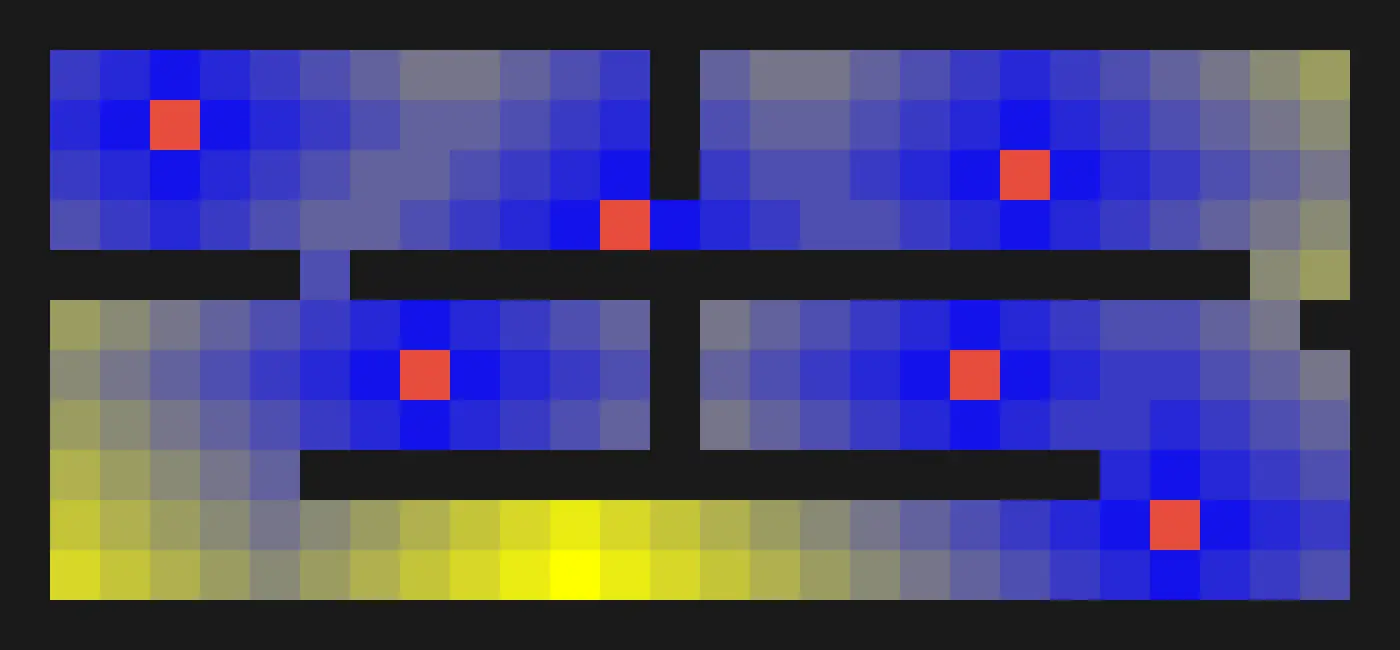
Fig. 7 — Where to put three traps so that a wandering pest reaches one soonest.
What kind of figure: exact · Place three traps. The map shows, on a toy field, the exact average time a wandering pest takes to reach one.
Where traps go on a farm or in a grain store is still largely a judgement call. A rat wandering there is a random walker; a trap is the target where its walk ends. That is first-passage maths — and placing traps by it could mean fewer chemical rodenticides.
Between the fellowship and the festival came the training: New Enterprise, the university’s start-up programme, with weekly workshops and a £150 award for BioPath in March 2026, then its Growth stage, which paired BioPath with a mentor from the university’s commercialisation team; and two rounds of coaching for a PechaKucha, a talk of 20 slides at 20 seconds each.
Watch on WeChat Channels — search 周易潇潇 in WeChat
· Awarded
Early Career Enterprise Fellow, 2026
The application, on 11 December 2025, proposed turning first-passage research into trap-placement software. On 23 December it won one of twelve places in the University of Bristol’s 2026 Early Career Enterprise Fellowship.
· Live
The BioPath platform: map in, traps out, proof attached
The software behind the fellowship: a Python platform with a command-line tool, an API and a static site with a demo that runs in the browser. It takes a site map and a monitoring budget and returns trap or sensor coordinates chosen so that a wandering pest is as likely as possible to be caught within a set time, together with an evidence bundle anyone can re-run (the repository calls it the proof bundle) — the optimised score against heuristic and random baselines, the worst-case score across stress-test scenarios and the Monte Carlo runs behind them. The maps in the repository are synthetic demos, and the project site is live.
BioPath’s own output on synthetic demo data, in its own colours: six recommended trap positions (red squares) over a map of expected time-to-encounter — blue is reached soonest, yellow takes longest.
· Presented
A PechaKucha (20 slides, 20 seconds each) at the Festival of Enterprise
Presented BioPath as a PechaKucha at the University of Bristol Festival of Enterprise in the Arts Complex on 10 June 2026, with a printed poster for the showcase and a one-line promise: ‘Map in. Traps out. Proof attached.’ The talk was also built as a web deck, and that same night it became a subtitled pitch video (now on WeChat Channels). For the fellowship showcase three weeks later, a five-minutepre-recorded version followed.
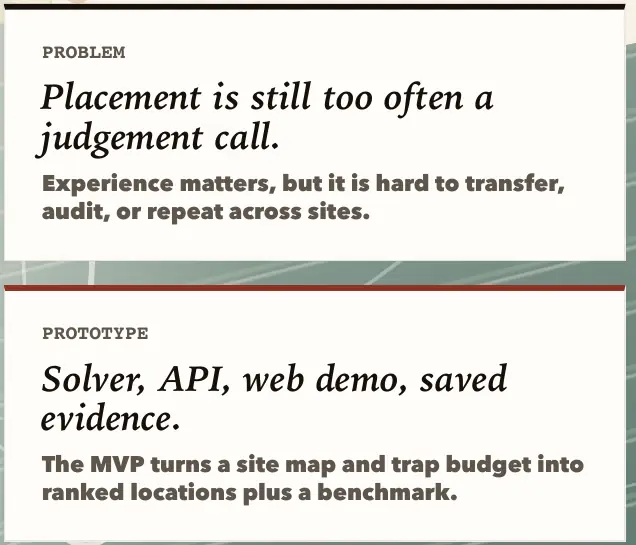
From the showcase poster, June 2026: the problem (placement is still a judgement call) and the prototype (solver, API, web demo, saved evidence).
· Published
‘From strawberry patch to PhD’
The University of Bristol Careers Service published a Student Founder Spotlight on 21 September 2026 — ‘From strawberry patch to PhD: how engineering maths inspired BioPath’ — on a PhD researcher in Engineering Mathematics building a trap-placement optimisation tool for pest control, and on the route through New Enterprise and the Early Career Enterprise Fellowship to the Festival of Enterprise.