
Westward 向西
Summer 2025: a university programme in Silicon Valley and a two-week research internship at LiveX AI, where the question was how to turn messy manuals into Markdown an AI can actually use. The hinge of the turn toward AI — and a walker that is still walking.
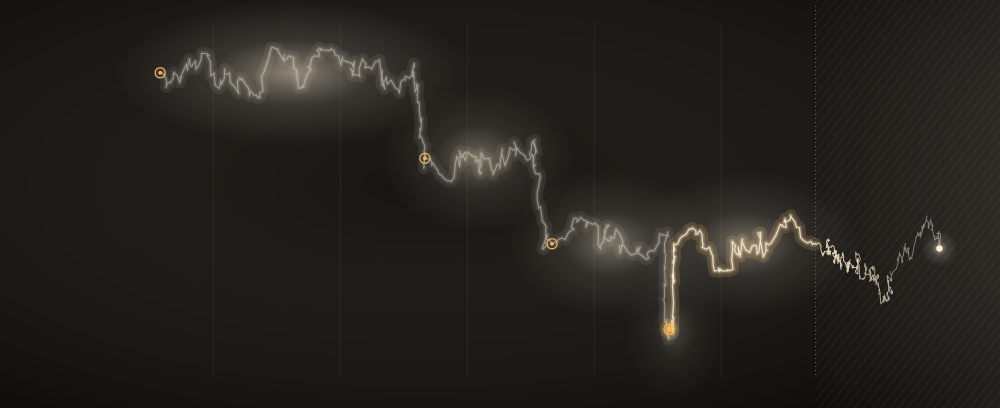
Fig. 9 — The one walker that has not been absorbed yet.
On the clock since 4 Aug 2025
t = 420 d
∞ still walking
as at 28 Sep 2026 · LiveX AI · research
- arrived
- 2,412
- still walking
- 1,588
time since 4 Aug 2025 (log scale)
The route so far
- Jul 2021TianjinMathematics and Applied Mathematics, Tianjin University Aug 2021
- Sep 2023Hong KongAn exchange year at HKUST Sep 2023
- Sep 2024BristolMSc Engineering Mathematics, University of Bristol Sep 2024
- Aug 2025Silicon ValleyLiveX AI — Researcher (Internship) 4 Aug 2025
- 4 Aug 2025∞ still walkingLiveX AI · research
Static print. The live figure runs with JavaScript.
The record
In the summer of 2025 the walk went west: a camp in Hong Kong, a university programme in Silicon Valley, and two weeks as a research intern at an AI start-up. It lasted about three weeks. It turned out to be the hinge.
The programme brought design thinking, company visits, a symposium at Stanford and evenings with founders. The internship brought a real question: which tool turns messy manuals into Markdown an AI knowledge base can actually use? The answer became an open benchmark that judges parsers by the questions they help answer.
What came after is still in motion. On the plate, it is the one walker that left through the right edge and has not been absorbed yet — its clock still counting.
Before: a CV sent twice in nine minutes
The earliest step of the summer is a CV emailed on 28 June 2025 to apply for Tianjin University's Silicon Valley programme — followed nine minutes later by a revised version. Everything westward starts with that small, slightly anxious double send.
Applied
HKUST Engineering summer camp
Selected for the HKUST School of Engineering's 2025 Summer Camp for Elite Students (21–25 July), a camp for prospective research postgraduates that included a visit to the Hong Kong Science Park. The first days in Hong Kong led straight on to the Bay Area — the opening of a three-city summer: Hong Kong, Silicon Valley, Bristol.
Selected
Silicon Valley Entrepreneurship Program
About three weeks in the Bay Area in the summer of 2025 on Tianjin University's Silicon Valley Entrepreneurship Program — the Xuanhuai School's ‘Stanford & Silicon Valley’ programme, run with Founders Space, a San Francisco venture builder, for a cohort of about twenty students. Arriving late from the Hong Kong camp, the weeks filled up with a design-thinking workshop, visits to Silicon Valley companies, a symposium at Stanford and evening founder-and-investor meetups — and, inside the same window, a research internship at LiveX AI.
Completed
A Saturday at Stanford Memorial Auditorium
The first weekend after landing in San Francisco meant a student ticket for the Saturday session of the Asian American Scholar Forum's Pioneer Medal Symposium and Ceremony at Stanford Memorial Auditorium, 26 July 2025 — the opening frame of the whole Bay Area chapter.
Design thinking: getting lost lights a beacon
In the first week on site the cohort took a Stanford-style design-thinking workshop, with the worked example ‘new students feel lost at Stanford’. Group 3's bilingual write-up turned getting lost into a feature: every wrong turn lights a community beacon and reveals a hidden story. It proposed four ‘bridges’ — E-ink beacon tags for leaving notes, a story-card deck whose AR clues unlock only on site, a sculpture projecting a live heat-map of wandering, and Bluetooth guide beacons carried by senior students — and scored wandering paths as ‘Bravery Points’. A random walk rewarded for wandering: the idea turns up again on this site.
Team concept
LiveX AI — Researcher (Internship)
About two weeks, 4–16 August 2025, as a research intern at LiveX AI, a Bay Area start-up whose AI helps consumer companies with customer support, retention and growth. The brief: find the most reliable way to turn product manuals and customer documents into clean, structured Markdown for the company's support knowledge base. The work ran from a survey of document parsers and a six-dimension quality rubric to a vendor compliance matrix for the engineering team, and ended in a retrieval-based benchmark that judges parsers by whether their output actually answers questions. CV line: LiveX AI — Researcher (Internship), Aug 2025.
Researcher (Internship)
Completed
A week in: an essay about a ladder in the clouds
About a week into the programme came a six-part Chinese reflection of roughly 1,700 characters: a night arrival and a ride with a driver who lived in his car; the Pacific coast and a quiet Stanford campus; walking into the campuses of the big technology companies; conversations with investors and founders; and dawn over the Alviso salt flats. It ends on motivation — everyone stands on a different rung of a ladder wrapped in cloud, so just take your own next step.
Completed
Week one: nine PDFs and a six-dimension rubric
The first week was a sprint: an investigation note on parsing benchmarks and popular tools, four converters run over nine representative test PDFs the same evening, and a written comparison the next day. When the engineering team asked for numbers and one more tool, a fifth was added, and by the end of the week a first deck scored the leading options from 0 to 10 on six dimensions — structural fidelity, formatting accuracy, special content, cleanliness, ease of post-processing and automation readiness. A follow-up request for something runnable set up the benchmark of week two.
Completed
An open retrieval-QA benchmark for document parsers
The internship's study became an open benchmark in its final week. Each parser's Markdown is treated as a knowledge base and judged by downstream usefulness rather than visual fidelity: the text is chunked, the best passages are retrieved, a model answers only from what was retrieved — and may say ‘not found’ — and every answer is scored by exact matching and then by a rubric judge. Wrong answers given with confidence are tracked separately as overconfidence. Five parsers, nine documents, a hundred questions per document: 900 questions for every parser.
Shipped
- Parsers × documents × questions
- 5 × 9 × 100
After: the summer, written into LinkedIn
The summer entered the public record twice: a ‘Researcher’ position at LiveX AI, added to LinkedIn in late August 2025 shortly after the internship; and, about five months later in January 2026, a ‘Silicon Valley Entrepreneurship Program Participant’ entry at Tianjin University, added as the profile turned toward enterprise. What came after the summer is still in motion; on the plate it is the walker that has not yet been absorbed.
Completed
Evidence ledger
| Date | Item | Status | Links |
|---|---|---|---|
| Before: a CV sent twice in nine minutes | Applied | no public link | |
| HKUST Engineering summer camp | Selected | no public link | |
| Silicon Valley Entrepreneurship Program | Completed | no public link | |
| A Saturday at Stanford Memorial Auditorium | Attended | ||
| Design thinking: getting lost lights a beacon | Team concept | no public link | |
| LiveX AI — Researcher (Internship) | Completed | no public link | |
| A week in: an essay about a ladder in the clouds | Completed | no public link | |
| Week one: nine PDFs and a six-dimension rubric | Completed | no public link | |
| An open retrieval-QA benchmark for document parsers | Shipped | no public link | |
| After: the summer, written into LinkedIn | Completed |