
Now & Next 此刻
As at the build date: a poster to present in Edinburgh, a paper submitted to Physical Review E and another in preparation, a desktop agent in development, a new teaching year and a second year as PGR rep. The walkers still in flight.
Fig. 12 — Walkers still in flight, as at the build date.
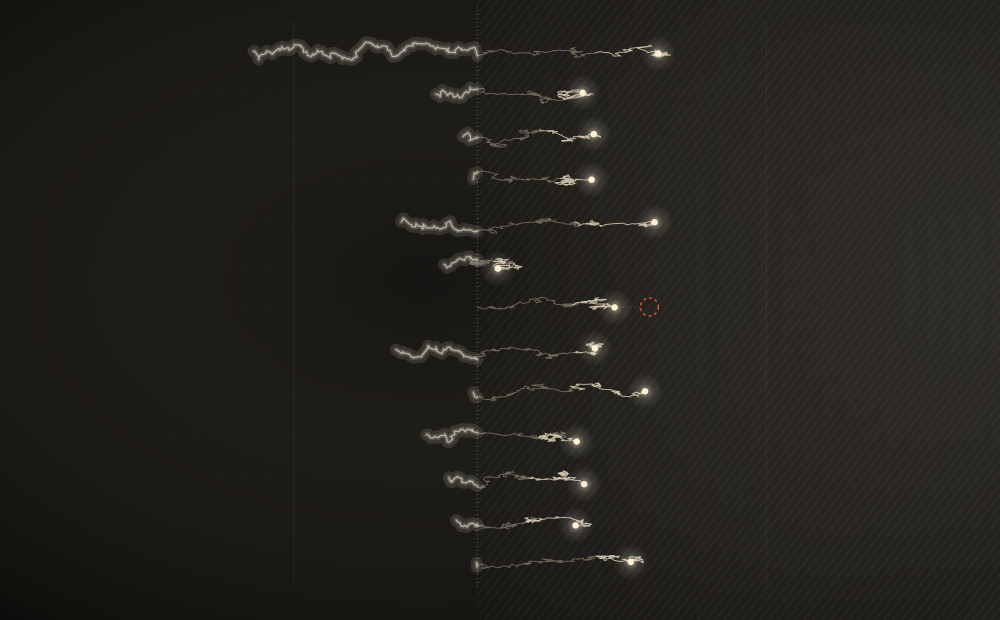
In flight
- PhD in Engineering Mathematics, University of BristolOngoing · since 3 Nov 2025 · 329 d
- Geometry-controlled folds — submitted to Physical Review ESubmitted to Physical Review E, Jul 2026 · since 30 Jul 2026 · 60 d
- prescribed-reaction-time-modes: a public reproduction archiveLive · since 8 Sep 2026 · 20 d
- Programmable multimodality — manuscript in preparationManuscript in preparation · since 23 Sep 2026 · 5 d
- Scaling to eight scriptsPlanned · since 9 Jun 2026 · 111 d
- What the next version will measurePlanned · since 11 Aug 2026 · 48 d
- UKAIRS 2026, EdinburghScheduled · 25 Nov 2026 · target · 24 Nov 2026 · T − 57 d
- AI lead (R&D), Yuexin InternationalOngoing · since Jun 2026 · ≈ 119 d
- From chat window to desktop agentIn development · since 23 Sep 2026 · 5 d
- 2026–27: thirteen roles across three schoolsOngoing · since 16 Jul 2026 · 74 d
- A returning rep for 2026–27Ongoing · since 18 Aug 2026 · 41 d
- A WeChat content studioLaunched · since 29 Aug 2026 · 30 d
- This site: First Passage, Nº 01Nº 01 · live · since 28 Sep 2026 · 0 d
Static print. The live figure runs with JavaScript.
in flight
A first-passage story is never finished while walkers are still in flight. As at the build date, these are the ones still moving — each with its own clock.
In November there is a poster to present in Edinburgh. A paper waits at Physical Review E and another is being prepared. A desktop agent is in development, a new teaching year has begun, and a second year as PGR rep. The plate's fog on the right edge is where these live.
This page is regenerated from the record at every build, so ‘now’ always means the date printed at the top.
Everything still ongoing, live, accepted or under review — walkers not yet absorbed.
PhD in Engineering Mathematics, University of Bristol
The PhD began on 3 November 2025 in the School of Engineering Mathematics and Technology (SEMT) at the University of Bristol. The subject is first-passage time: how long a random walker takes to reach a target for the first time, and why the distribution of that time can split into two peaks. Over the first year the work has broadened to span stochastic processes and the evaluation of AI agents. The random walks moving across this page are the same kind of object the thesis studies.
PhD researcher
∞ still walking
Ongoing
Computing on the Isambard supercomputers
From December 2025 the heavy computation ran on Bristol's national supercomputers, as part of a university project on random walkers in disordered environments. Command-line automation syncs code, submits SLURM jobs and fetches results. Isambard-AI carried the continuum-bridge production for the encounter paper — lattice ladders refined up to n = 33 and Brownian dynamics with 2×10⁷ walkers per release position — and Isambard 3 ran the large-scale checks for the fixed-budget paper in September 2026, including a census of 2×10⁹ walkers.
∞ still walking
Ongoing
- Walkers in one census
- 2×10⁹
A public, bilingual research atlas
On 25–26 February 2026 the first-passage line got its own public website: a static research atlas in English and Chinese, with a continuous ‘book’ of eight chapters, a page for every report, a theory section, interactive figures and typeset mathematics. It maps 27 reports and tracks 130 claims back to their evidence. The repository behind it is organised ‘agent-first’ — one command-line tool, guardrail tests and a machine-readable report registry — so that people and AI agents can work on it in the same way.
∞ still walking
Live
- Book chapters
- 8
- Mapped reports
- 27
- Tracked claims
- 130
Geometry-controlled folds — submitted to Physical Review E
‘Geometry-controlled folds of first-passage-time bimodality under localized absorption’ was submitted to Physical Review E as a single-author regular article on 30 July 2026. It is the first paper of the PhD and the capstone of the double-peak line: the geometry of a localized absorber decides whether a second arrival peak exists at all, and the peak is lost through a saddle-node fold whose location can be computed exactly. Every figure on this site that shows the effect is generated by our own simulations, not taken from the manuscript.
Submitted to Physical Review E, Jul 2026
prescribed-reaction-time-modes: a public reproduction archive
Everything behind the fixed-budget paper is public and checkable: simulation, analysis and plotting code, machine-readable numerical records, interval-arithmetic certificates, the Lean 4 sources and the Isambard 3 job records, each tied to SHA-256 manifests. Five releases went out between 8 and 26 September 2026 as the paper was rebuilt — about 1,466 files in the latest, including 100 Python scripts, 27 Lean files and 1,198 JSON records. Anyone can re-run the numbers without asking.
∞ still walking
Live
- Releases
- 5 (v1.0.0 → v1.3.0)
- Files in v1.3.0
- ≈ 1,466
Programmable multimodality — manuscript in preparation
‘Programmable multimodality and saddle-node loss of reaction-time peaks under a fixed catalyst budget’ is a single-author manuscript in preparation. A fixed amount of static catalyst, split into thin stripes along the path of a reacting Brownian pair, programs the reaction-time density: at weak noise each stripe removes a fixed fraction of the arriving pairs — a stick-breaking law — so there is exactly one peak per stripe, and designs with prescribed peak times and weights exist, are locally unique and can be found by Newton's method. Fixed-width stripes can instead lose a late peak through a saddle-node bifurcation, certified by interval arithmetic in test cases. The finite-dimensional and calculus core is checked in Lean 4; the stochastic parts are proved by hand.
∞ still walking
Manuscript in preparation
An AI-native way of doing mathematics
Across the first-passage line a repeatable loop took shape: AI models propose derivations and code, separate agents attack the claims, numerical computation acts as the arbiter, and exact algebra is machine-checked in Lean 4. The documented cases include proposed formulas that failed numerical checks and were discarded, a repository-grounded audit that caught errors an outside model could not see, and multi-round reviews — up to about sixty agents in a single audit — before each submission. The principle in one line: AI can generate more scientific possibilities; the research skill is deciding which ones deserve belief.
∞ still walking
Ongoing
- Agents in one audit
- ≈ 60
- Lean-checked theorems (fold paper)
- 46
A research line that bends toward AI
Alongside first-passage research on random walks, the PhD work broadened during 2026 toward AI: evaluating LLM agents, human–AI interaction and multilingual input, and using multi-model AI workflows as research instruments — adversarial audits whose disagreements are settled by computation. The habit carries straight over: measure the hidden route, then refuse to believe the number until something independent confirms it. The UKAIRS 2026 acceptance is its first peer-reviewed AI output.
∞ still walking
Ongoing
Scaling to eight scripts
The next study was built before a single call was spent: 44 tasks across eight languages (264 prompt variants), split into high-risk exact-script tasks and controls; a fixed matrix of frontier models; a statistics engine with paired bootstrap confidence intervals; and generators for every table and figure. An adversarial audit from eight native-fluency perspectives replaced four homophone pairs that did not truly collapse. The main run is waiting on a go/no-go decision, so there are no multilingual results yet — and none are claimed.
∞ still walking
Planned
- Tasks · languages · variants
- 44 · 8 · 264
What the next version will measure
What comes next: position the work against related research; match the title to the zh-CN evidence; soften the design rule to fit the small homophone samples; run a small typing study, so that both sides of the effort–quality trade-off are measured rather than modelled; build about thirty homophone tasks with graded ambiguity to trace a real performance curve; pin every model version; and look harder at why ‘normalise first’ hurts. The eight-language harness is ready for the broader claim.
∞ still walking
Planned
Accepted: the first AI paper
On 11 August 2026 UKAIRS accepted the paper for a poster session in the Emerging Research track. The reviews found the question genuinely interesting, the artefact useful-looking and the inclusivity angle worth pursuing, and recommended leading with the ‘shi shi’ example and the three-layer analysis — encoding change, compression, tone loss. It is the first peer-reviewed AI paper, first-authored.
∞ still walking
Accepted
UKAIRS 2026, Edinburgh
The UK AI Research Symposium runs on 24–25 November 2026 at the John McIntyre Conference Centre in Edinburgh, and the poster is up on Wednesday 25 November. The plan, written into the paper: a side-by-side demo showing, for each task, the native prompt, its keyboard-friendly variant, the agent's response, the grade and the effort estimate — so that visitors can toggle from routine prompts to exact-term stress prompts and watch where meaning collapses. Chapter 02 of this site is a first draft of that demo.
∞ still walking
Scheduled · 25 Nov 2026
AI lead (R&D), Yuexin International
From June 2026, alongside the PhD, AI lead (R&D) at Yuexin International (阅信国际), a cloud-communications company working across messaging, voice and AI. The brief has three parts: the company's AI platform and model gateway; its AI transformation — moving teams from trying AI to working with it every day; and AI support for the international messaging business. The entries below are what got built.
AI lead (R&D)
∞ still walking
Feishu MCP connectors: agents inside the workspace
A suite of MCP connectors that lets coding agents work inside the company's Feishu workspace — documents, wiki, sheets, multi-dimensional tables, chats, meeting minutes, approvals and project tracking — acting as the signed-in person rather than as an all-powerful bot. It is a policy layer over the official connector plus custom bridges: per-profile tool allow-lists, secrets held in the system keychain, and a permission tool that automates scope upgrades. Written documentation made it something colleagues could install, not just a demo.
∞ still walking
Live
An internal AI gateway with Feishu single sign-on
Within four days an open-source LLM gateway became the company's internal AI platform, the YueXin Intelligent Open Platform. The gateway was chosen by reading the source code of two candidates rather than their brochures. The work covered a deployment runbook, white-labelling and full Chinese localisation of the admin interface, a mobile layout, and a self-service portal where colleagues sign in with Feishu, get a key and see their own usage. Router retries, fallbacks and per-member budgets followed, and a production-grade audit of model and permission boundaries closed the week.
∞ still walking
Live
A morning briefing written by an agent
The sales team asked for more than a daily list of links, so a scheduled agent was built instead. Every morning at 08:30 Beijing time it reads official public procurement notices, extracts the buyer, budget, scope and requirements, connects each notice to the same buyer's earlier notices, and writes a follow-up recommendation into a shared table. Everything with consequences — registering, buying documents, pricing, submitting — stays with people.
∞ still walking
Live
An enterprise platform for governed AI access
The company's enterprise AI unified-access and governance platform went from local build to a public site in a week, launching on 31 July 2026. It is a self-built portal over an open-source gateway: organisations, teams and virtual keys, model allow-lists, budgets and usage, a data-loss-prevention hook and an audit hash-chain, with the gateway's own admin interface closed to the internet. Around launch it went through several rounds of adversarial review by parallel AI agents; privacy-canary checks that planted synthetic identifiers and confirmed none survived in storage or logs; and formal production acceptance, with a receipt for every model.
∞ still walking
Live
Zijing Career Compass
Zijing Career Compass is an AI career-matching platform for a university's Beijing centre. Students upload a CV, confirm the profile the system builds from it, and see explainable matches against employers on six dimensions, next to a radar of talent policies. The first version was built overnight from meeting notes and went live after a front-end rebuild, followed by a whole-site audit. Later versions added separate workspaces for students, employers and staff, and machine-checked ‘truth gates’ that stop banned wording, personal data and sample placeholders before anything ships. Operations were then handed over to the product owner. The demo runs on synthetic data.
Platform developer
∞ still walking
Live
YueXin AI Assistant — web and Windows
In one day, an assistant for company staff was built and launched on the company's model gateway. Colleagues sign in with Feishu and are provisioned automatically, with a personal monthly quota and self-serve API keys. The web app streams its answers, folds away the model's reasoning, renders Markdown and maths, accepts images and has light and dark themes; a Windows desktop client shipped alongside it, with a download page. Before release it went through three parallel security reviews and an independent review by a second model.
∞ still walking
Live
From chat window to desktop agent
The desktop assistant is becoming a coding and office agent: an open-source agent engine underneath, a YueXin interface on top. Before the change, three domestic models were shown to complete real coding tasks through the company gateway. The next rounds add quota requests, governance telemetry, a web agent with sandboxed code execution, web search and file reading, a built-in browser, and acting in Feishu on the person's behalf — with a confirmation before every send, share or approval — plus a diff panel and terminal, scheduled tasks, skills and plugins. Telemetry is metadata only, and every employee can see all of it on a ‘My data’ page.
∞ still walking
In development
The company's LinkedIn page
Set up and launched the company's LinkedIn page overnight on 10–11 June 2026, ahead of MWC Shanghai: logo, cover, tagline, about text, website, industry and size, kept strictly on the Yuexin International brand. The artwork came from a brand pack made by a colleague; the work here was the page itself — and the decision that the company should have one before the show.
∞ still walking
‘People. Connected.’ — a contact site for the delegation
A contact microsite for the Wholesale World Congress delegation, reached from a 19 mm QR code on each business card: a page per person with messaging, LinkedIn, email, website and save-contact links, plus a browser-based card editor so that each person can maintain their own. It went live on the company's connect subdomain and was decode-tested card by card.
∞ still walking
Live
An interactive SMS market map
A market map shared internally one morning became a public, dependency-free web page the same day: five columns of buying logic; six customer segments with their explicit and implicit needs; three use cases — one-time passcodes, transactional notices and permission marketing — each with metrics and typical objections; the flows of supply, money and feedback; and a seven-step path to a deal. It exports PNG and per-segment briefs, prints cleanly, and was revised to V1.1 the same day after three separate AI review passes on content, usability and release safety.
∞ still walking
Live
Running the teaching the AI-native way
Behind the teaching sits a workflow: all teaching-support material organised into a structured course hub with an index written for AI agents, and agents that rebuilt a whole term's allocations, timetable clashes and weekly plans from mail records, calendars and shared rotas. It is the same method as the research — structure first, then let agents do the tedious reconstruction, then check it — applied to thirteen teaching roles.
∞ still walking
Ongoing
2026–27: thirteen roles across three schools
For 2026–27, thirteen teaching roles across eleven units in three schools. In Mathematics: Perspectives in Data Science and Perspectives in Mathematics, support sessions for Theory of Inference, marking for Quantum Computation and a tutorial group for Introduction to Pure Mathematics. In SEMT: demonstrating and marking for Engineering Mathematics 1, group supervision in Mathematical and Data Modelling 3, labs in Statistical Computing and Empirical Methods, and Foundations of AI. In CADE: AI-Driven Design and Simulation, and the group research project of the new MSc in Engineering with AI. A Linear Algebra tutorial group was added in September.
∞ still walking
Ongoing
- Teaching roles
- 13
- Units
- 11
- Schools
- 3
An offline, bilingual teaching library
For the first tutorial of Introduction to Pure Mathematics, a tablet-first web app was built and tested in a day: an English-first teaching script and a bilingual reference library of 39 topics — overviews, prerequisites and strategies — that works offline, with mathematics typeset locally and no tracking of any kind. The same site now carries a Linear Algebra section.
∞ still walking
Live
- Topics
- 39
How to say my name
The first post as rep in the SEMT PhD community, on 5 January 2026, opened with a pronunciation guide — Xiaoxiao is ‘SHYOW-shyow’, /ʃjaʊ ʃjaʊ/ — then a line about the research (random walks on lattices, first-passage problems) and an invitation to send feedback to the School. Later posts passed along opportunities: a translational funding call, a study group with industry, and volunteers for the faculty's PhD induction panel.
∞ still walking
Ongoing
Student Ambassador at the open days
Signed on as a University of Bristol Student Ambassador in April 2026 and worked the undergraduate open days on 12–13 June, which welcomed about 28,000 visitors across the two days — wearing a home-designed ‘Ask me about…’ poster for Engineering Maths and AI. Signed up again for the 31 October 2026 open day.
∞ still walking
Ongoing
A returning rep for 2026–27
Bristol SU confirmed a second year as the Engineering Mathematics PGR Academic Rep on 18 August 2026. The new year began with helping bring new PhD reps into the team and keeping the School's PhD community space open to newcomers; the faculty rep forums resume in November.
∞ still walking
Ongoing
The BioPath platform: map in, traps out, proof attached
The software behind the fellowship: a Python platform with a command-line tool, an API and a static pitch site. It takes a site map and a monitoring budget and returns trap or sensor coordinates that optimise first-passage capture, together with a proof bundle anyone can re-run — the optimised score against heuristic and random baselines, a robust worst-case score and the Monte Carlo runs behind them. An automated benchmark loop has pushed nearly two thousand benchmark commits on its own, and the pitch site is live.
∞ still walking
LinkedIn as a public notebook
Until this site, LinkedIn was the de facto public page: the QR codes on the enterprise poster and on the ambassador posters point there, and so, for most of 2026, did zhouyixiaoxiao.com. Its posts are the milestones — starting the PhD, the enterprise fellowship, the festival pitch. The profile had 888 followers at an April 2026 snapshot.
∞ still walking
A WeChat content studio
In August 2026 an AI-assisted studio was set up to turn years of phone footage into short videos for WeChat Channels (视频号) and a WeChat Official Account (公众号). Four goals frame it: map every video in the archive; build a voice and a digital presence with clear AI disclosure; profile the speaking style and suggest how to improve it; and semi-automate publishing — with the final ‘publish’ click always made by a person. The transcription route is chosen and the pipeline is built; the topic map, and a ‘memory galaxy’ for this site, come next.
Launched
This site: First Passage, Nº 01
The site you are reading, in its first edition: a live first-passage experiment in which walkers leave Tianjin and search a luminous plate of 2021 to now for whatever you choose to measure. It replaces the page that, since April 2026, simply forwarded zhouyixiaoxiao.com to LinkedIn. It was designed and built with a large team of AI agents working to one specification, with every fact drawn from a verified, privacy-tagged record — and nothing private shipped.
∞ still walking
Nº 01 · live
On GitHub since December 2021
The GitHub account dates from 1 December 2021. For three years it was quiet — coursework, a maths guide, a template — and then, in 2026, it erupted: most of the repositories were created that year, along with nearly all of the contributions, including a two-day spike when an automated agent factory built a hackathon product. The live counts on this page are fetched from GitHub at build time. Company work in private repositories is not counted, so the graph is a lower bound, not the whole output.
∞ still walking
Ongoing
The Tianjin University maths guide
Instead of only using the curriculum, write a guide to it for everyone who comes after. Built from July 2023, the Tianjin University maths undergraduate guide gathers what a student needs — a foreword, the professional courses, the majors and how to contribute — first as a quick guide with a document library, then as a MkDocs site. It has been served at zhouyixiaoxiao.info since December 2025 and is the oldest thing on this page that other people still use.
∞ still walking
London Cuts
A creator tool for documenting a single-place trip with photos grounded in their own metadata, written stories and AI-generated postcards in six styles, switchable between three visual modes — Fashion, Punk and Cinema — with public reader pages, a map atlas and PDF or PNG export. The live demo tells ‘A Year Around London’ in thirteen stops and ‘A Week in Reykjavík’, and it has entry points for AI agents too: an llms.txt, an OpenAPI description and an MCP endpoint. London Cuts is a working name.
∞ still walking
A fashion-editorial housing map
A single-page map for incoming Chinese LLM students at Bristol: seventeen student housing options within about a twenty-minute walk of the Law School, each tagged by how its information was sourced — verified, provider, search or live — with an application section, a mobile detail panel and an offline basemap fallback. Built in a weekend, with an editorial look borrowed from fashion magazines.
∞ still walking
A legal-career roadmap for Bristol LLM students
A responsive, editorial-style Chinese guide for Bristol LLM students planning a legal career back in China in 2026–27: chapter navigation, full-text search, filterable events and recruitment, a four-week practice plan, ten copy-ready templates, dated updates on official AI products and 42 primary sources — with no analytics and no backend. The same editorial language as the housing map: a small shelf of Bristol guides.
∞ still walking